
No rentals match your filters
Your filters hide all 210 rentals in this area.Remove a filter to see more:No min to $500Condo
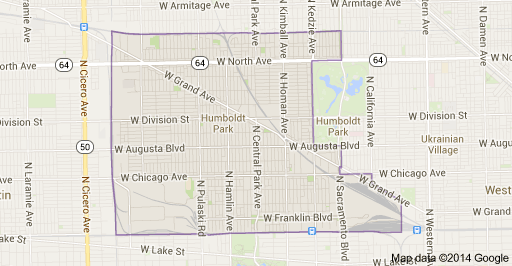
Welcome to Humboldt Park. This vibrant, ethnically-diverse neighborhood was founded in 1869 by German immigrants to honor naturalist and geographer Alexander von Humboldt. His name was bestowed upon the neighborhood's most popular local park?307 acres of beautiful land that's now the epicenter of the area and host to a number of ethnic celebrations. In the past, the park was the historic setting of a number protests and uprisings throughout the years. Despite its reputation for a fair amount of crime, with a combination of vintage three-flat buildings, single-family homes and a host of new construction projects, Humboldt Park is a rapidly developing and culturally diverse neighborhood attracting visitors from other neighborhoods and cities. With authentic Puerto Rican cafes and markets next to eclectic art galleries and shops, there's something here for everyone.

Humboldt Park's boundaries are North Avenue to the north, Chicago Avenue to the south, Western Avenue to the east, and Pulaski Road to the west. The neighborhood is 6.8 miles from downtown Chicago and is easily accessible via public transportation by taking the Blue Line elevated train (Division stop) or the 65-Grand, 66-Chicago or 70-Division bus lines.

The neighborhood's aptly named Humboldt Park, a multifaceted facility for the community, is a popular gathering place. Its field house features the Puerto Rican Arts and Culture Museum, plus a fitness center, two gymnasiums, meeting rooms and an inland beach. During the day the park is very family-friendly, fit for strollers and pets; at night, it often plays hosts to community-oriented festivals and high-profile live music concerts.
Ethnically and culturally diverse, the neighborhood is developing into one of the trendiest areas in Chicago. It's lively, boasting plenty of family-friendly restaurants, modern cocktail lounges and coffeehouses. Price points for properties are slightly lower than those in nearby Bucktown, Logan Square and Wicker Park, making Humboldt Park ideal for young families or burgeoning young professionals. Additional surrounding neighborhoods are Avondale, River West and Ukrainian Village.
Humboldt Park is a combination of single (49%) and married (27.3%) people. Most residents (57.6%) are childless. Those in their 20s , 30s and 40s are 43.3% of the population.


The commute to work is 30-60 minutes for 62.2% of Humboldt Park residents, with 37.8% traveling less than 30 minutes to work.
Humboldt Park is close to the John F. Kennedy Expressway (Interstate 90), which connects to I-94 and I-190. The neighborhood is within walking distance to METRA (Metropolitan Rail) and the CTA (Chicago Transit Authority) Blue Line stations. A public transportation commute to the Loop from Humboldt Park takes approximately 40 minutes. The neighborhood is 6.8 miles from downtown Chicago and is easily accessible via 22-Clark, 66-Chicago and 70-Division buses. Humboldt Park is 2.6 miles away from the Wicker Park neighborhood via the Blue Line Damen Street station.


With Humboldt Park the nucleus of the neighborhood, it's a hub of activity, from community-oriented festivals to live music events. The annual Puerto Rican People's Day Parade, which has occurred for almost 50 years, is the most anticipated June event with live entertainment, food and family activities. Riot Festival, a large music event, also takes place in the park. The festival features major hip-hop, punk and rock acts, attracting fans from all over the country. A number of popular Puerto Rican restaurants can be found in Humboldt Park, including Papa's Cache Sabroso and La Plena Restaurant. The Mexican-focused Cemitas Puebla is also a neighborhood favorite.
Humboldt Park has always been known as a melting pot. German immigrants settled here first, in 1869, followed by Danish and Norwegian homesteaders in the 1870s. Polish, Italian and Jewish immigrants made their way here in the early to mid-1900s; Puerto Rican immigrants arrived in the 1950s and 1960s. With the Civil Rights Movement creating a climate of rebellion and confrontation across the country in the 1960s, Humboldt Park experienced its first riots in 1966. The historic Division Street Riots, which took place for three days in June of that year, were among the first Puerto Rican uprisings in the United States. The riots erupted after a Chicago Police officer shot a young Puerto Rican man. The historic significance of the era lives on in the Paseo Boricua, a six-block stretch of Division Street that is the only Puerto Rican-themed commercial corridor in the country. Ten authentic Puerto Rican restaurants as well as other businesses line the street and two giant gateway flags welcome visitors into the fold.
Similar to the Near West Side neighborhoods Avondale, Logan Square and Ukrainian Village, Humboldt Park continues to develop and thrive despite the occasional crime story in the news.
2422 W. Division Street - The Poseo Boricua, a six block stretch on Division Street that is the only Puerto Rican-themed commercial corridor in the country
2500 W. Division Street - The Sea of Flags Mural, which was feature in the opening credits of Nothing Like The Holidays, a 2008 film starring Humboldt Park native Freddy Rodriguez
2329 N. Monticello Avenue - The family home featured in the film Nothing Like The Holidays
1002 N. California Avenue - The California Clipper, a post-Prohibition-era cocktail lounge still thriving with live music and classic cocktails
3015 W. Division Street - Institute of Puerto Rican Arts & Culture, which showcases the culture and fine arts of the Puerto Rican community